Guide to Eating for Hormonal Health
May 4, 2026NUTRITION GUIDE
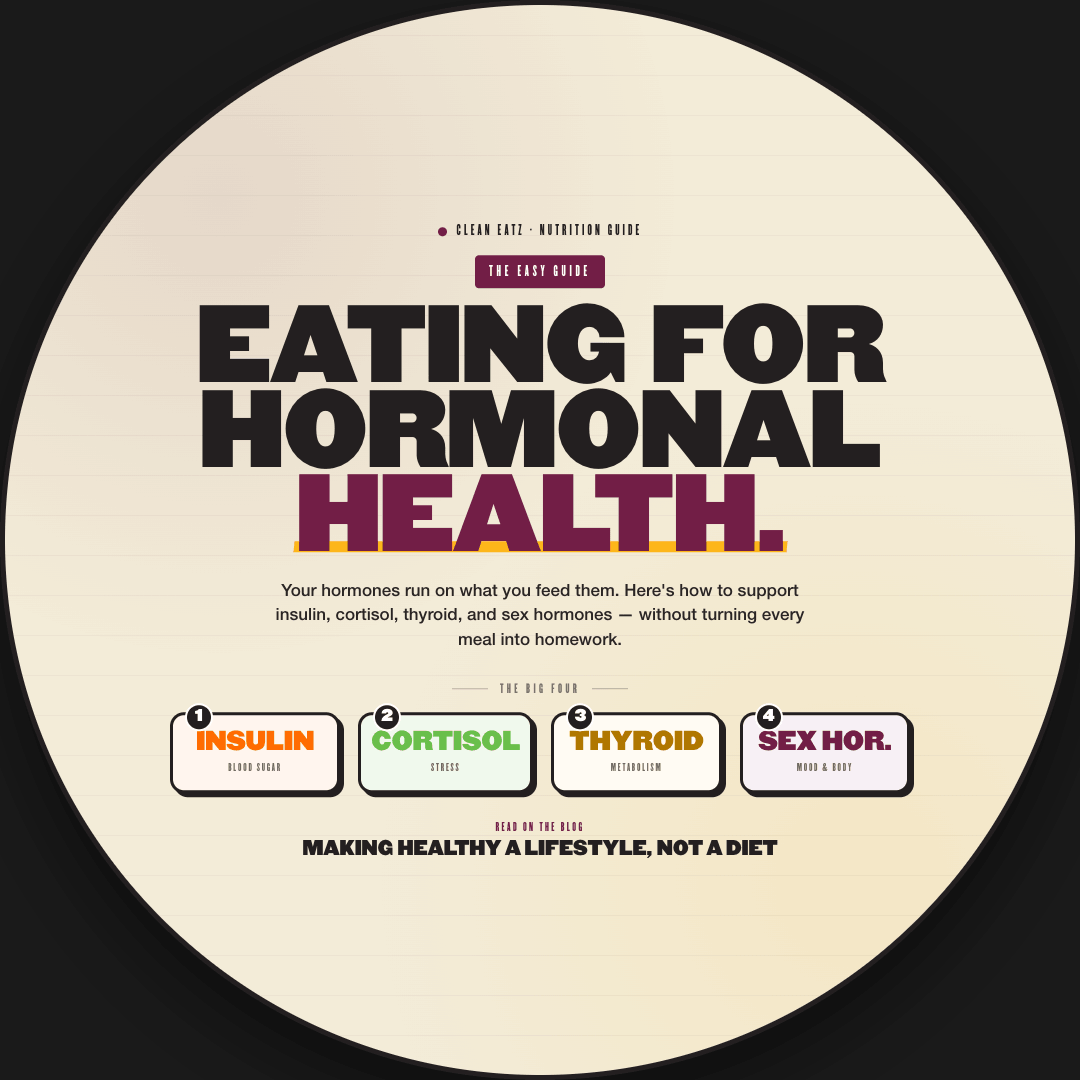
Eating for Hormonal Health:
The Easy Guide
Your hormones run on what you feed them. Here's how to support insulin, cortisol, thyroid, and reproductive hormones — without turning every meal into a research project.
You can take supplements, optimize your sleep, manage your stress, and exercise five days a week — but if your nutrition is off, your hormones will let you know.
Fatigue that doesn't go away with rest. Cravings that won't quit. Weight that clings to your midsection no matter what you do. Mood swings. Brain fog. Low energy at 2pm every single day. These aren't random — they're signals. And more often than not, the root cause traces back to what's on your plate.
The good news: you don't need a degree in endocrinology to eat in a way that supports your hormones. You need a few key principles, the right foods in the right amounts, and a system that makes it easy to stay consistent. That's what this guide is for.
🧮
Start With Your Numbers
Hormonal nutrition starts with eating the right amounts of protein, carbs, and fat for your body. Our free macro calculator gives you personalized daily targets in under 2 minutes.
GET YOUR MACROS →THE BIG FOUR
The 4 Hormones Your Diet Affects Most
Your body produces dozens of hormones. But when it comes to what you eat, four of them respond the most — and they drive almost everything you feel day to day.
1. Insulin
Controls blood sugar · Drives fat storage · Affects energy and cravings
Insulin is released every time you eat — especially when you eat carbohydrates. Its job is to shuttle glucose from your blood into your cells for energy. The problem starts when insulin spikes too high, too often: your cells stop responding as effectively (insulin resistance), you store more fat (especially around the midsection), your energy crashes after meals, and your cravings for sugar and carbs intensify.
What to eat:
Pair every meal with adequate protein — it slows glucose absorption and blunts the insulin spike. Choose complex carbs over refined ones (brown rice over white, whole grain pasta over regular). Include healthy fats. Avoid eating large amounts of carbs by themselves. Consistent meal timing also helps — erratic eating patterns force insulin to work harder.
2. Cortisol
Stress response · Inflammation · Belly fat · Sleep quality
Cortisol is your body's stress hormone. It's not inherently bad — you need it to wake up in the morning and respond to threats. But chronically elevated cortisol (from stress, poor sleep, and yes, poor nutrition) drives inflammation, breaks down muscle tissue, increases belly fat storage, and disrupts sleep. And here's the feedback loop: when cortisol is high, you crave sugar and processed carbs, which spike insulin, which drives more fat storage, which increases inflammation, which raises cortisol further.
What to eat:
Protein with every meal stabilizes blood sugar and prevents the crashes that trigger cortisol spikes. Reduce processed foods and excess sugar — both are inflammatory and elevate cortisol. Eat enough food (undereating is a stressor your body responds to with cortisol). Don't skip meals. Research shows that a Mediterranean-style diet rich in whole foods, vegetables, and lean proteins can significantly reduce fasting cortisol levels over time.
3. Thyroid Hormones
Metabolism · Energy · Body temperature · Weight regulation
Your thyroid sets the pace for your metabolism. When thyroid function is sluggish (hypothyroidism), everything slows down — you gain weight easily, feel tired constantly, get cold easily, and struggle to lose fat even in a caloric deficit. Nutrition directly influences thyroid function: your body needs specific nutrients to produce thyroid hormones, and certain dietary patterns can impair thyroid signaling.
What to eat:
Adequate protein is essential — your thyroid needs amino acids (especially tyrosine) to produce T3 and T4 hormones. Selenium (found in chicken, eggs, and beef) and zinc are critical cofactors. Avoid severely restricting calories — very low-calorie diets downregulate thyroid function as a protective mechanism, which is counterproductive for weight loss. Eat enough, and eat consistently.
4. Estrogen & Testosterone
Reproductive health · Mood · Body composition · Bone density
Both men and women need balanced levels of estrogen and testosterone for energy, mood stability, muscle maintenance, bone health, and reproductive function. These hormones are particularly sensitive to body fat levels (excess fat increases estrogen production), dietary fat intake (healthy fats are literal building blocks for sex hormones), and blood sugar stability (insulin resistance disrupts sex hormone balance).
What to eat:
Don't fear fat — your body needs dietary fat to produce estrogen and testosterone. Focus on healthy fats from sources like eggs, lean meats, and nuts. Maintain adequate protein to support muscle mass (which influences testosterone). Keep body fat in a healthy range through consistent nutrition and exercise. And manage blood sugar — insulin resistance is one of the most common disruptors of sex hormone balance, especially in conditions like PCOS.
THE PLAYBOOK
5 Nutrition Principles for Hormonal Balance
You don't need a complicated protocol. These five principles, applied consistently, support all four of the hormones above.
1. Protein at Every Meal
This is the single highest-leverage change you can make. Protein stabilizes blood sugar (insulin), reduces cortisol-triggering crashes, provides building blocks for thyroid and sex hormones, and keeps you full longer. Most people need 1.0–1.6g per kg of body weight daily. Our free macro calculator will give you your exact target.
2. Don't Fear Fat — But Choose Wisely
Fat is essential for hormone production. Cutting it too low starves your endocrine system. But the type matters: prioritize monounsaturated and polyunsaturated fats, limit trans fats and excessive saturated fat from processed sources. Whole food sources of fat (eggs, lean meats, nuts, avocados) are the best foundation.
3. Stabilize Your Blood Sugar
Blood sugar stability is the foundation of hormonal balance. Every spike and crash ripples through insulin, cortisol, and downstream into thyroid and sex hormones. The fix: eat balanced meals (protein + carbs + fat together), don't skip meals, choose complex carbs over refined, and keep portions consistent. Pre-portioned meals with known macros take the guesswork out entirely.
4. Eat Enough (Seriously)
Undereating is one of the most common causes of hormonal disruption — especially in women. Severe calorie restriction raises cortisol, downregulates thyroid function, drops sex hormones, and triggers metabolic adaptation that makes weight loss harder, not easier. If you're eating under 1,200 calories and feeling terrible, the problem might not be your willpower — it might be that you're not eating enough. The macro calculator will show you what "enough" actually means for your body.
5. Be Consistent (Not Perfect)
Your hormones respond to patterns, not single meals. One piece of cake doesn't wreck your hormones. But three weeks of erratic eating, skipped meals, and fast food absolutely does. The goal isn't perfection — it's a reliable baseline of balanced, protein-rich meals that your body can depend on. Consistency is the hormone signal your body trusts.
THE EASY PART
How Clean Eatz Makes Hormonal Nutrition Easy
Knowing what to eat is one thing. Actually doing it — every day, every meal, while working and parenting and living — is another. That's the gap Clean Eatz fills.
Every meal on the weekly menu is macro-balanced with adequate protein, controlled carbs, and appropriate fat — the exact profile that supports all four hormones in this guide. The macros are printed on every label so you always know what you're eating. The meals rotate every week so you don't burn out. And they're ready in under 3 minutes so "I didn't have time to cook" is no longer a reason to skip a meal or hit a drive-through.
~29g
Avg protein per meal
(this week's menu)
368
Avg calories per meal
(balanced, not restrictive)
6
New meals every week
(variety prevents burnout)
Need goal-specific meals? Our bundles are built for targeted nutrition: the Shred Bundle keeps carbs around ~25g/meal for blood sugar control and fat loss, the Builder Bundle adds extra protein for muscle and hormone support, and the GLP-1 Bundle maximizes protein per calorie for satiety and lean mass preservation.
On peptide therapy? We built a dedicated guide for that: Peptide Nutrition 101 →
🧮
Find Your Personal Macro Targets
Hormonal nutrition starts with knowing your numbers. Under 2 minutes. Completely free.
GET YOUR MACROS →THE SIGNALS
Signs Your Hormones Might Be Out of Balance
These symptoms are common — but they're not normal. If several of these sound familiar, nutrition is the first lever to pull:
Energy & Metabolism
Constant fatigue even with enough sleep, afternoon energy crashes, feeling cold all the time, unexplained weight gain (especially around the midsection), difficulty losing weight despite eating less
Mood & Cognition
Anxiety that spikes without clear cause, irritability, brain fog, difficulty concentrating, mood swings, feeling "wired but tired" at night
Appetite & Cravings
Intense sugar cravings, never feeling full, or losing your appetite entirely, blood sugar crashes between meals, needing caffeine to function
Reproductive & Physical
Irregular periods, acne that won't clear, hair thinning, low libido, poor recovery from workouts, bloating
If you're experiencing multiple symptoms, consider working with a healthcare provider. Nutrition is a powerful tool — but sometimes you also need testing and professional guidance to identify the root cause.
REAL RESULTS
People Who Made the Switch
"Clean Eatz is a great option for those seeking to lose weight and dial in on their eating habits. I have a family of four and having meals on deck for them really allows for us to spend the time we would be in the kitchen with each other."
— Josh O. · 5/5 · May 2026
"These meals taste very good and have high protein, low carbs. So much easier than frozen meals and I take them to work every morning."
— Kimberly V. · GLP-1 Meals · May 2026
Feed Your Hormones Right.
Start with your macros. Then order meals that hit those numbers.
GET YOUR MACROS → ORDER THIS WEEK'S MEALS →Find Your Local Clean Eatz
120+ locations in 23 states. Fresh meals prepared every week at your local café.
This content is for educational purposes only and is not medical advice. Hormonal health is complex and individual. If you suspect a hormonal imbalance, consult with a qualified healthcare provider for testing, diagnosis, and personalized treatment.
MAKING HEALTHY A LIFESTYLE, NOT A DIET.
Categories
- All Categories
- Exercises and Fitness
- GLP-1
- Gluten Free Diet
- Healthy Eating
- Healthy Recipes
- High Protein Diet
- Keto Diet
- Meal Prep Tips and Hacks
- News
- Weight Loss