Guide to Visible Muscles
May 11, 2026FITNESS + NUTRITION GUIDE
Your Easy Guide to
Visible Muscles
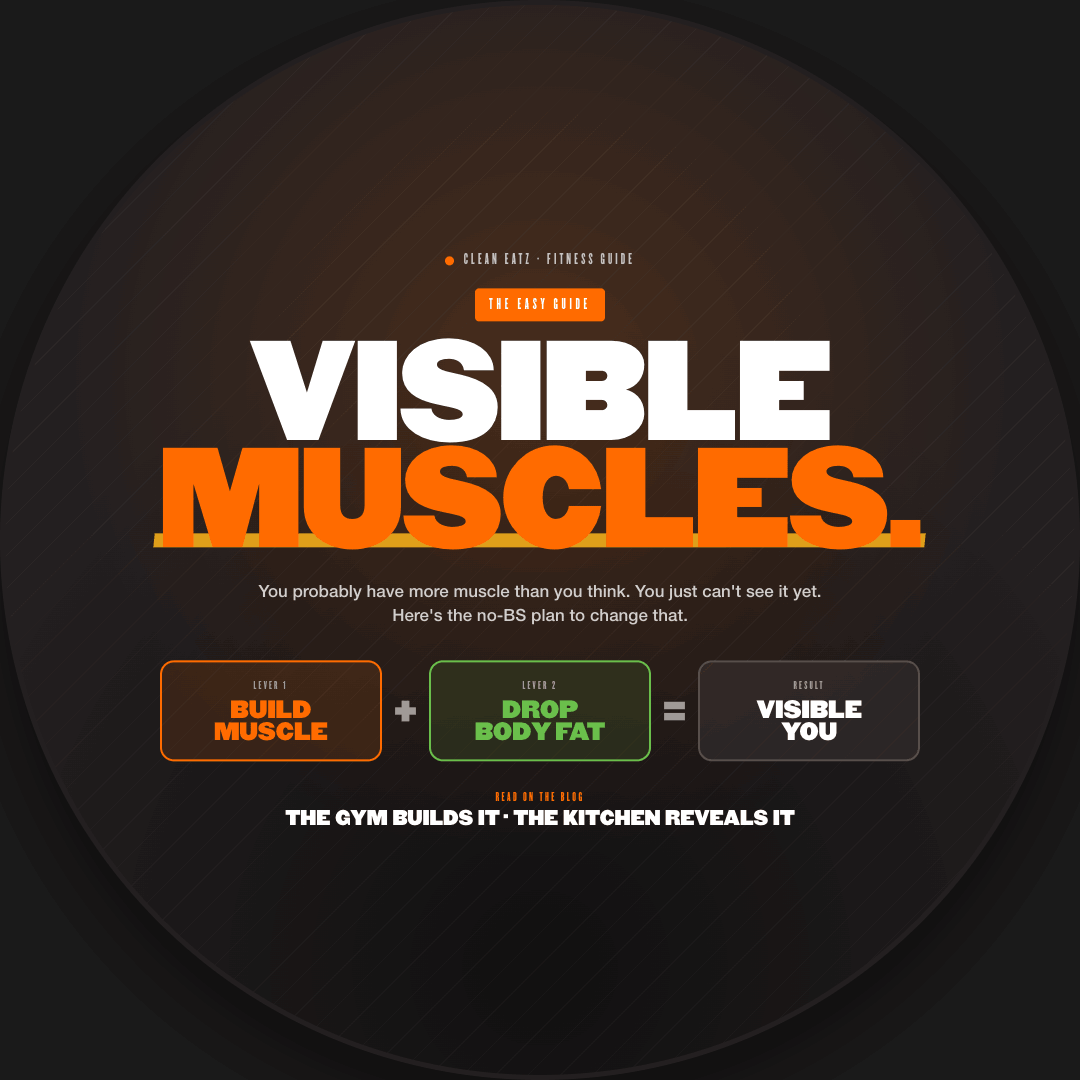
You probably have more muscle than you think. You just can't see it yet. Here's the straightforward plan to change that — even if you're over 30, busy, and haven't touched a barbell in years.
Let's skip the part where someone tells you to "just eat clean and lift heavy" as if that's a plan.
Here's what's actually true: visible muscles come down to two variables. That's it. You need enough muscle mass to see (which most guys who've ever trained already have more of than they realize), and you need low enough body fat for that muscle to show. Everything else — the supplements, the specific exercises, the argument about rep ranges — is noise until those two things are handled.
This guide covers both. No bro-science, no 6-day-a-week gym commitment, no meal plan that requires you to eat tilapia and asparagus for the rest of your life. Just the mechanics of what actually works, a 4-day workout plan you can finish in 45 minutes, and a nutrition system that takes zero cooking.
Whether you're 32 or 52, this works. The physics haven't changed.
🧮
Step 1: Know Your Numbers
Visible muscles start in the kitchen. Get your personalized daily targets
for calories, protein, carbs, and fat in under 2 minutes.
THE FORMULA
Visible Muscles = Muscle Mass + Low Enough Body Fat
That's the entire equation. Every decision you make in the gym and the kitchen is pulling one of these two levers. Understanding which lever to pull — and when — is the difference between spinning your wheels and actually seeing results in the mirror.
Lever 1: Build/Keep Muscle
Driven by: resistance training + protein intake
Without enough muscle, there's nothing to reveal when body fat drops. Resistance training creates the stimulus. Protein provides the building blocks. You need both. No amount of cardio or dieting creates muscle — only lifting does.
Lever 2: Reduce Body Fat
Driven by: caloric deficit + consistency
Most men start seeing muscle definition around 15–18% body fat. At 12–15% you see clear definition. Under 12% you see veins and striations. The way to get there: eat in a moderate caloric deficit while keeping protein high enough to preserve the muscle underneath.
The mistake most guys make: they try to do both at once without a plan. They eat too little (lose muscle), or they eat too much (never lean out), or they do a ton of cardio (burn everything including muscle) and end up lighter on the scale but looking the same in the mirror. The key is a moderate deficit with high protein and consistent lifting. Not extreme. Not complicated. Just disciplined.
THE KITCHEN
The Nutrition That Actually Reveals Muscle
You've heard "abs are made in the kitchen." It's a cliché because it's true. Here's what the science actually says you need:
Protein: 1.6–2.2g per kg of body weight
This is the most well-supported range in sports nutrition research for muscle building and preservation. For a 180lb (82kg) guy, that's 131–180g of protein per day. Non-negotiable. This is the one number you cannot fudge. Our macro calculator will give you your exact target.
Caloric Deficit: 300–500 calories below maintenance
Not 1,000. Not 800. A moderate deficit preserves muscle while losing fat. Extreme deficits trigger cortisol, burn muscle for energy, crash testosterone, and leave you looking flat. Slow and steady wins the visible muscle game. Your macro calculator will tell you your maintenance number — subtract 300–500 from there.
Meal Timing: 3–5 meals with 25–40g protein each
Research shows your body can only use so much protein per sitting for muscle protein synthesis (roughly 0.4–0.55g per kg per meal). Spreading protein across multiple meals throughout the day maximizes the muscle-building signal. This is why eating one massive 120g-protein dinner doesn't work as well as four 30g-protein meals.
Consistency: 90% compliance beats 100% intensity
The best nutrition plan is the one you actually follow. If your meal prep routine falls apart by Wednesday, you don't need more discipline — you need a better system. More on that below.
The Practical Problem (and How to Solve It)
You know what to eat. The problem is actually doing it — consistently, with accurate macros, week after week, while working 50 hours, managing a household, and trying to have a life.
This is where most guys fail. Not because they lack knowledge. Because they lack a system.
Clean Eatz solves the execution problem. Every meal has exact macros on the label — protein, carbs, fat, calories. This week's menu averages 29g protein and 368 calories per meal. You order online, pick up at your local café, and eat macro-balanced meals all week without cooking, prepping, or tracking anything.
For guys who need higher protein, the Builder Bundle adds an extra 2oz of protein to every meal. For guys who want to accelerate fat loss with lower carbs, the Shred Bundle keeps carbs around ~25g per meal. Both are 5 meals for $52.70–$53.70 and rotate with the weekly menu.
New menu every week · 120+ locations · Ready in under 3 minutes
THE GYM
The 4-Day Workout Plan
Upper/Lower split · 4 days/week · 45 minutes per session · Progressive overload focus
Built for guys who want results without living in the gym. Compound movements prioritized for maximum muscle stimulus in minimum time.
Day 1: Upper Body (Strength)
Monday · Heavy compound focus · 45 min
| Exercise | Sets × Reps | Rest |
|---|---|---|
| Barbell Bench Press | 4 × 6–8 | 2–3 min |
| Barbell Row | 4 × 6–8 | 2–3 min |
| Overhead Press | 3 × 8–10 | 2 min |
| Weighted Pull-ups or Lat Pulldown | 3 × 8–10 | 2 min |
| Face Pulls | 3 × 15–20 | 60 sec |
Day 2: Lower Body (Strength)
Tuesday · Heavy compound focus · 45 min
| Exercise | Sets × Reps | Rest |
|---|---|---|
| Barbell Back Squat | 4 × 6–8 | 2–3 min |
| Romanian Deadlift | 3 × 8–10 | 2 min |
| Bulgarian Split Squat | 3 × 10/leg | 90 sec |
| Leg Curl | 3 × 10–12 | 90 sec |
| Standing Calf Raise | 4 × 12–15 | 60 sec |
Day 3: Rest or Light Cardio (Walk, Bike, Swim)
Day 4: Upper Body (Hypertrophy)
Thursday · Higher reps, more volume · 45 min
| Exercise | Sets × Reps | Rest |
|---|---|---|
| Incline Dumbbell Press | 3 × 10–12 | 90 sec |
| Cable Row | 3 × 10–12 | 90 sec |
| Lateral Raise | 3 × 12–15 | 60 sec |
| Dumbbell Curl | 3 × 10–12 | 60 sec |
| Tricep Pushdown | 3 × 10–12 | 60 sec |
Day 5: Lower Body (Hypertrophy)
Friday · Higher reps, more volume · 45 min
| Exercise | Sets × Reps | Rest |
|---|---|---|
| Leg Press | 3 × 10–12 | 90 sec |
| Walking Lunge (Dumbbell) | 3 × 12/leg | 90 sec |
| Leg Extension | 3 × 12–15 | 60 sec |
| Seated Leg Curl | 3 × 12–15 | 60 sec |
| Hanging Leg Raise or Ab Wheel | 3 × 12–15 | 60 sec |
Days 6–7: Rest · Walk · Live Your Life
The Rule That Makes It All Work: Progressive Overload
Every week, try to do slightly more than last week — add 2.5–5lbs to the bar, do one more rep, or reduce rest time by 10 seconds. This is the signal your body needs to build muscle. If you're lifting the same weight for the same reps you did 3 months ago, nothing is changing. Your muscles grow in response to increased demand, not repetition. Track your lifts. Even a notes app works. If last week you squatted 185 for 6, this week aim for 185 for 7 or 190 for 6.
REALISTIC TIMELINE
How Long Until You See Results?
Here's what to expect if you follow the workout plan above and keep your nutrition consistent:
Weeks 1–4: The Foundation
Your body adapts to the stimulus. Strength goes up (mostly neurological). You feel better. Scale may not move much. Trust the process.
Weeks 4–8: Visible Changes Start
Clothes fit differently. Arms look fuller. Waist starts tightening. Other people may start noticing before you do.
Weeks 8–16: Real Transformation
Muscle definition visible. Shoulders broader. Midsection leaner. Strength significantly up from Day 1. This is where consistency pays off exponentially.
Month 6+: The Lifestyle Phase
You're not "on a program" anymore — this is just how you live. Maintenance becomes easier because you've built the habits and the system. Muscle keeps improving as long as progressive overload continues.
The Gym Builds the Muscle.
The Kitchen Reveals It.
Get your macro targets. Then let us handle the meals.
GET YOUR MACROS → ORDER THIS WEEK'S MEALS →Find Your Local Clean Eatz
120+ locations in 23 states. Fresh meals every week. Macros on every label.
This guide is for educational purposes only and is not medical or fitness advice. Consult with a qualified professional before starting any new exercise program, especially if you have pre-existing injuries or health conditions. Results vary based on individual factors including genetics, consistency, sleep, and stress management.
MAKING HEALTHY A LIFESTYLE, NOT A DIET.
Categories
- All Categories
- Exercises and Fitness
- GLP-1
- Gluten Free Diet
- Healthy Eating
- Healthy Recipes
- High Protein Diet
- Keto Diet
- Meal Prep Tips and Hacks
- News
- Weight Loss